.png?1779465398)
Trilingualism in Berrechid: what exactly are we talking about?
When we talk aboutBerrechid trilingual school, it is not simply a matter of adding a few more hours of English to a traditional program. Trilingualism, as we practice it at Aphélie School Group, is a structured educational approach where Arabic, French and English coexist in the child's day from kindergarten onwards.
In a real Berrechid trilingual school, each language is associated with identified moments, subjects and sometimes speakers. The child understands very early that the world is spoken in several languages, and that each has its own beauty.
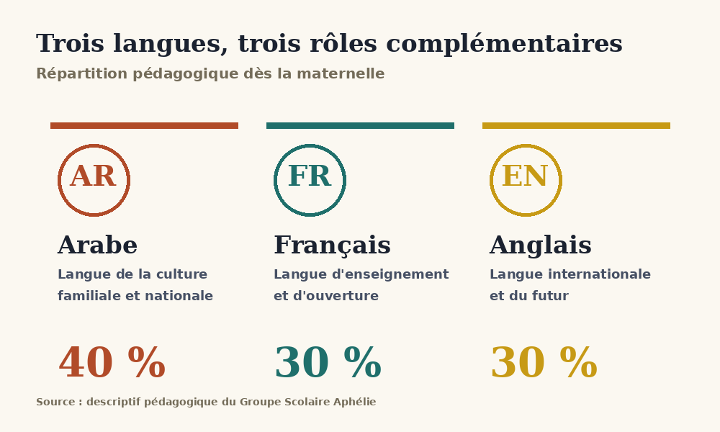
Educational distribution
Our educational project offers a balanced distribution between the three languages, from kindergarten onwards: approximately 40% of the time in Arabic, 30% in French and 30% in English. This distribution evolves over the cycles while keeping the same principle: no language is secondary.
The 7 benefits of early trilingualism
Research in cognitive sciences is converging: growing up with several languages, from a very young age, presents several lasting advantages for the child's development. Here are the main ones, and how a Berrechid trilingual school as Aphélie concretely activates them.
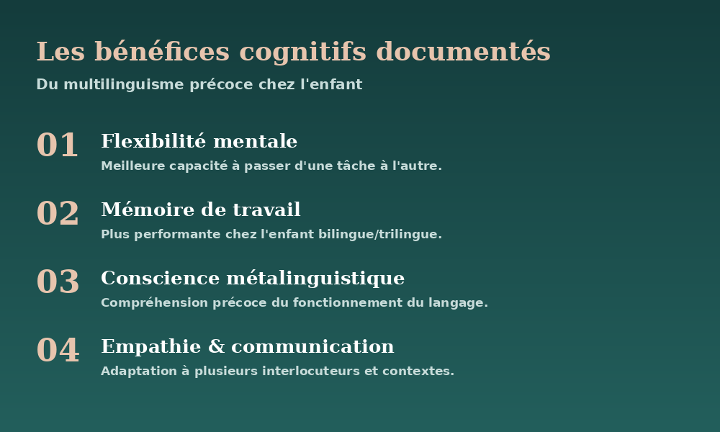
Increased mental flexibility. Children who regularly switch from one language to another develop cognitive agility that transfers to other tasks. He learns to change frames of reference quickly — a valuable skill for his entire education and future professional life.
Better working memory. Dealing with multiple language systems trains short-term memory. This can be seen from kindergarten in the ability to remember long instructions, complex nursery rhymes, and later to study.
Early metalinguistic awareness. The trilingual child understands very early that language is a system. He questions sounds, structures, meaning — which often makes him a better academic learner.
Communicational empathy. Living with several languages also means living with several cultures. The child develops a natural attention to others, to their way of speaking, to their point of view.
A broadened professional horizon. In Morocco and internationally, mastery of Arabic, French and English opens the doors to a much wider range of studies and careers.
A solid cultural anchor. Arabic has a central place in our curriculum because it is the language of culture, history and family for most of our students.
Self-confidence that develops early. The child who knows how to say “hello”, “thank you” and “goodbye” in three languages very quickly develops self-confidence that radiates beyond languages.
How does our trilingual teaching work on a daily basis?
In a Berrechid trilingual school seriously, trilingualism is not just a poster promise. It results in a precise educational organization, which we apply daily.
Dedicated times
Each language has its times of day, its activities, and sometimes its teachers.
Pace respected
No language learning is forced. Each child progresses at their own pace.
Various media
Nursery rhymes, games, readings, workshops, outings, projects — all our materials revolve around the three languages.
Individualized monitoring
Each term, the teaching team reviews progress with parents.
Three myths to deconstruct about trilingual schools
When we talk about a trilingual school in Berrechid, some preconceived ideas often come up. Here are the ones we hear the most, and our well-founded response.
Children are naturally wired to learn multiple languages. This is how hundreds of millions of children around the world grow up, without any cognitive disorders. Rather, the lasting benefits are documented by research.
Occasional mixing — called “code-switching” — is part of normal language development in young children. It naturally decreases with age and the educational organization of the school. Trilingual adults do not mix their languages.
Research shows the opposite: the earlier exposure to languages begins, the better the phonetic and structural acquisition. Waiting is precisely what makes long-term learning difficult.
At what age to start? The perfect time
The golden window for language learning is between 0 and 7 years old. The child's brain is at this time exceptionally plastic, and assimilation occurs without conscious effort.
Concretely, the sooner your child joins a Berrechid trilingual school, the more natural the acquisition of the three languages will be. Our kindergarten welcomes children from 2 years old, precisely to take advantage of this privileged period.
If your child is older, it's not too late: he or she will adapt, but with a little more conscious effort. Our educational team can discuss with you the best way to welcome them.
Frequently asked questions from parents
No. The majority of our young students arrive with a dominant language. It is precisely the role of the trilingual kindergarten to offer them a natural exposure to the two other languages, without stress and at their own pace.
No way. Speak the language you know best, the one in which you tell stories, express your emotions, share your roots. The school takes care of exposing the child to the other two languages in a structured setting.
In the very short term, some trilingual children may have a slightly smaller vocabulary in each individual language, but the total — all languages combined — is much higher. In the long term, that's what matters.
Yes. The official program constitutes the obligatory base, enriched by our linguistic approach. Our goal is not to deviate from it, but to elevate it.
? Come and discover our trilingual kindergarten
The best way to convince yourself of the relevance of a Berrechid trilingual school is to come and see it working. We organize visits to the kindergarten by appointment.